Closing the Market: What a Year of Financial Education Taught Us Closing the Market: What a Year of Financial Education Taught Us

“I hope you leave here feeling that markets are not something happening somewhere else, to somebody else. They are places in which you can participate, companies you can understand and careers you can shape.” — Julia Hoggett, CEO, London Stock Exchange
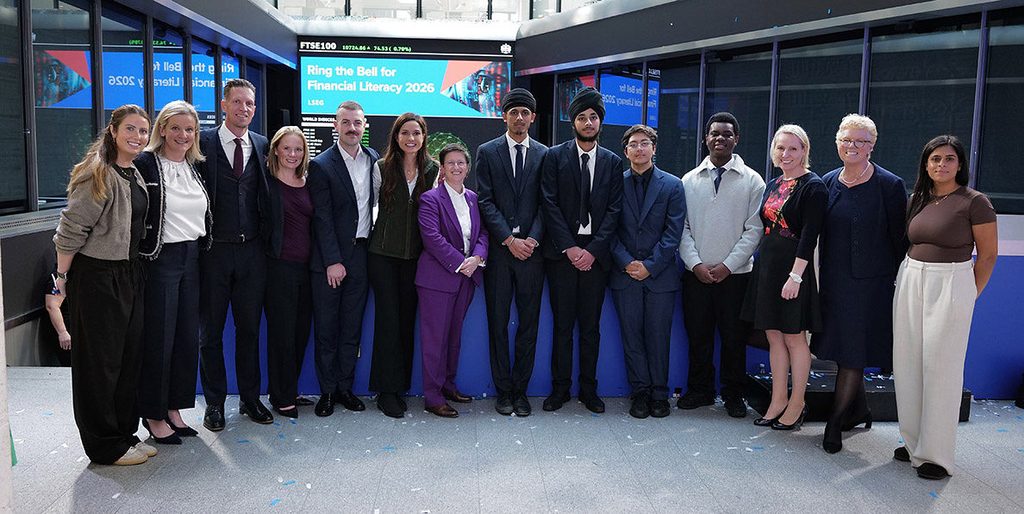
Julia spoke those words to 40 students on Wednesday 14 October, moments after they had closed the market at the London Stock Exchange.
The closing ceremony is one of the Exchange’s oldest traditions, and it is usually performed by some of the world’s most successful businesses and leaders. On this day, the honour belonged to young people.
It was the final day of Understanding Money, Markets and Risk, a year-long pilot with one simple aim: to make the world of money and markets feel like something young people can be part of, not something that happens to them.
Why this matters
In England, statutory financial education stops at 16. That is exactly the age when young people take their first wage, sign their first tenancy and start making decisions that will shape their financial future. Even the reform arriving in 2028 won’t close that gap.
That timing is not a technicality. Financial education is one of the most direct tools we have for breaking cycles of poverty. Without it, young people in low-income households are more exposed to debt traps, fraud and economic shocks, the high risks that keep disadvantage in place across generations.
Some young people grow up hearing the language of money, markets and careers at the kitchen table. Others have just as much ability and ambition, but far less sight of how the system works.
Julia put it plainly to the students. “Finance doesn’t belong only to people in suits, using long words and too many acronyms. It shapes the choices we can make, the risks we can take and the opportunities we can pursue. Financial literacy isn’t about being told what to do with your money. It’s about having the confidence to decide for yourself.”
What we built together
This year, Founders4Schools partnered with LSEG and Goldman Sachs to pilot Understanding Money, Markets and Risk: a free, post-16, curriculum-aligned programme. We offered it to schools and colleges across the UK, which were then chosen because their students face higher socioeconomic disadvantage. These are the young people with the most to gain from financial confidence and, historically, the least access to it.
The programme combined two things:
- 10 curriculum modules with quizzes, covering everything from payslips, budgeting and credit to investing, diversification and risk.
- A live trading simulation and stock-picking competition on TradeTutor, where students could test strategies and feel the consequences of risk for themselves.
In total, 781 students and teachers registered on the platform.
None of it built itself. Expert volunteers gave their own time to record 31 instructional videos, and others visited a school in person to sit with students in the room.
In August, students from the programme joined a two-day careers and financial literacy boot camp at the London Stock Exchange, alongside young people from partner organisations across the UK.
What the evidence shows
Across every measure of financial knowledge we tracked, students moved in a positive direction. This wasn’t one lucky result but a consistent pattern, and students noticed it themselves: in our programme evaluation, 77% said the programme significantly improved their understanding of money and markets.
The before-and-after results bear this out:
| What we measured | Before | After |
| Students who understand the risk–return relationship | 60% | 86% |
| Students who understand income, tax and deductions | 58% | 83% |
| Students who understand diversification | 40% | 69% |
The biggest gains came in the concepts students were least likely to know at the start. Teachers saw it too: 12 of 18 educators observed stronger reasoning around risk and uncertainty, independently confirming what students reported.
As Julia told the students, “they didn’t simply complete some modules. They learned to think differently. Successful investing isn’t about following the loudest voice on social media or hunting for a shortcut. It’s about research, judgement, patience and understanding that reward rarely comes without risk.”
That shift showed up in how students think about their own money. 71% now think more about long-term goals, and 61% are more careful with spending. 91% would recommend the programme to another student.
As one student put it:
“I have an interest in Finance but I found reading papers like the Financial Times too difficult before. Now I can!”
The reach mattered as much as the results. 83% of the schools we worked with were outside London, across six regions of England, and several had Free School Meal eligibility well above the national average. 83% of educators said the programme filled real gaps in their curriculum, and the same proportion would run it again.
Finals Day: closing the market
Finals Day began at Goldman Sachs. A panel of professionals spoke candidly about how they got where they are, then the students walked the trading floor.
From there, they went to the London Stock Exchange. After official welcomes, our top four students pressed the button to close the market, with all 40 finalists alongside them. Julia joked that it was an impressive thing to have on your CV before you’ve even left sixth form!
Among the guests was Ellie Beasley, who has championed the programme at Goldman Sachs and began her own career at the London Stock Exchange. It was a reminder that careers in finance can take you to all sorts of places, and sometimes right back to where you started.
For many students, especially those who travelled down from Manchester, these were buildings they had only ever seen from the outside. One said the day felt like a “simulation” because it was so surreal.
The students noticed who had made time for them, too. One teacher wrote to us afterwards:
“The students were absolutely buzzing after it… It was not lost on the students how senior these people were, and it really made them feel that the day held huge value.”
The day didn’t promise anyone a job, and it wasn’t meant to. What it did was make a demanding career visible: the standards it sets, the preparation it takes and the people who do it. As one teacher told us, what stayed with them most was this:
“…they really emphasised that work ethic and engagement were key, not social background.”
That is the message we want every young person to hear, and to believe.
From pilot to something bigger
This year answered one question: does this work in 29 schools? The next question is bigger. What would it take for every school that needs it to have access?
Today, more than 110 organisations spend around £13.5 million a year on financial education, yet post-16 students are still largely left out. Only 17% of teachers feel confident delivering it. The problem isn’t a lack of goodwill. It’s that the effort is fragmented.
We want to help change that by connecting schools, employers and collaborating with other charities so that the right opportunity reaches the right classroom. If your organisation shares our ambition, we’d love to hear from you.
Our sincere thanks to the LSEG Foundation, Goldman Sachs and every volunteer who gave their time, and to the teachers who supported their students throughout.
As was said on the day, maybe some of these students will return one day to ring the bell as CEOs, investors or leaders in their own right. Sometimes all it takes is one door opened, one honest conversation and one afternoon in the right room for a young person to think: that could be me.


