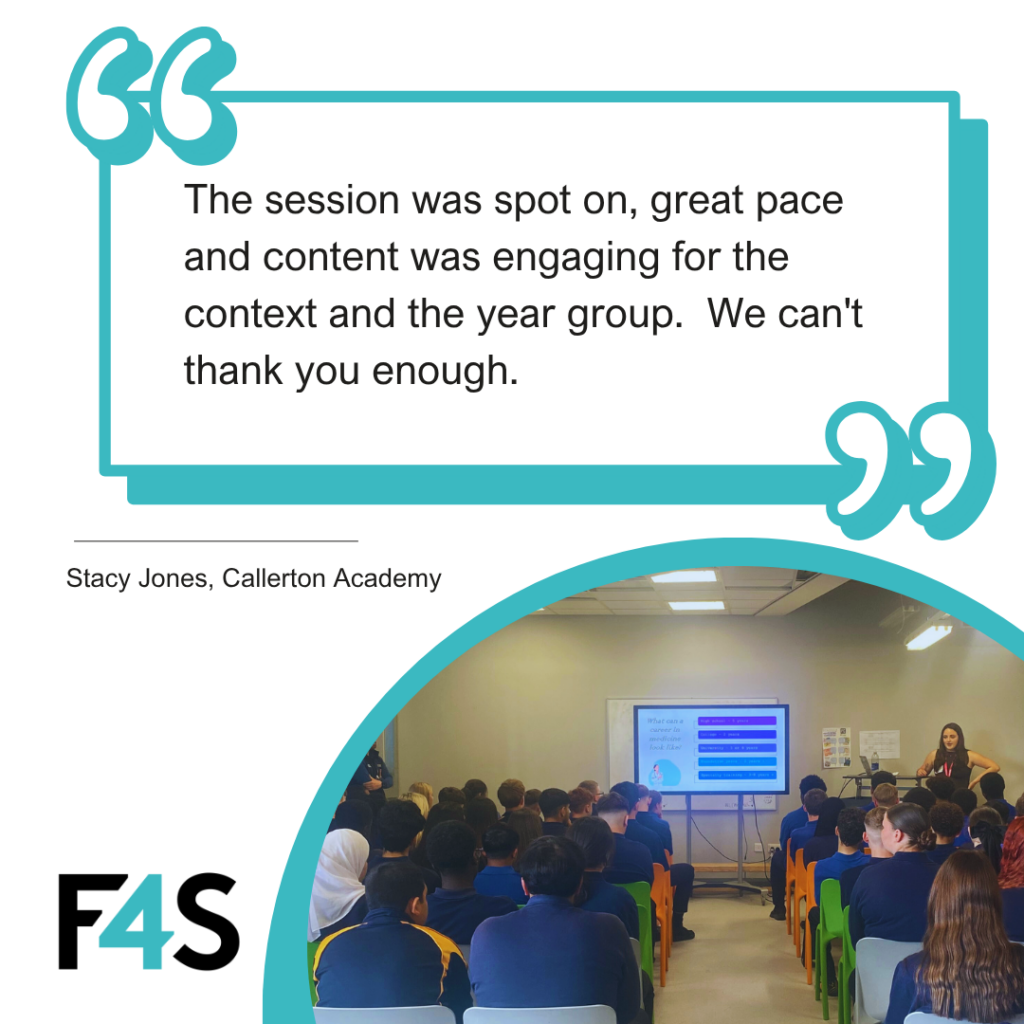
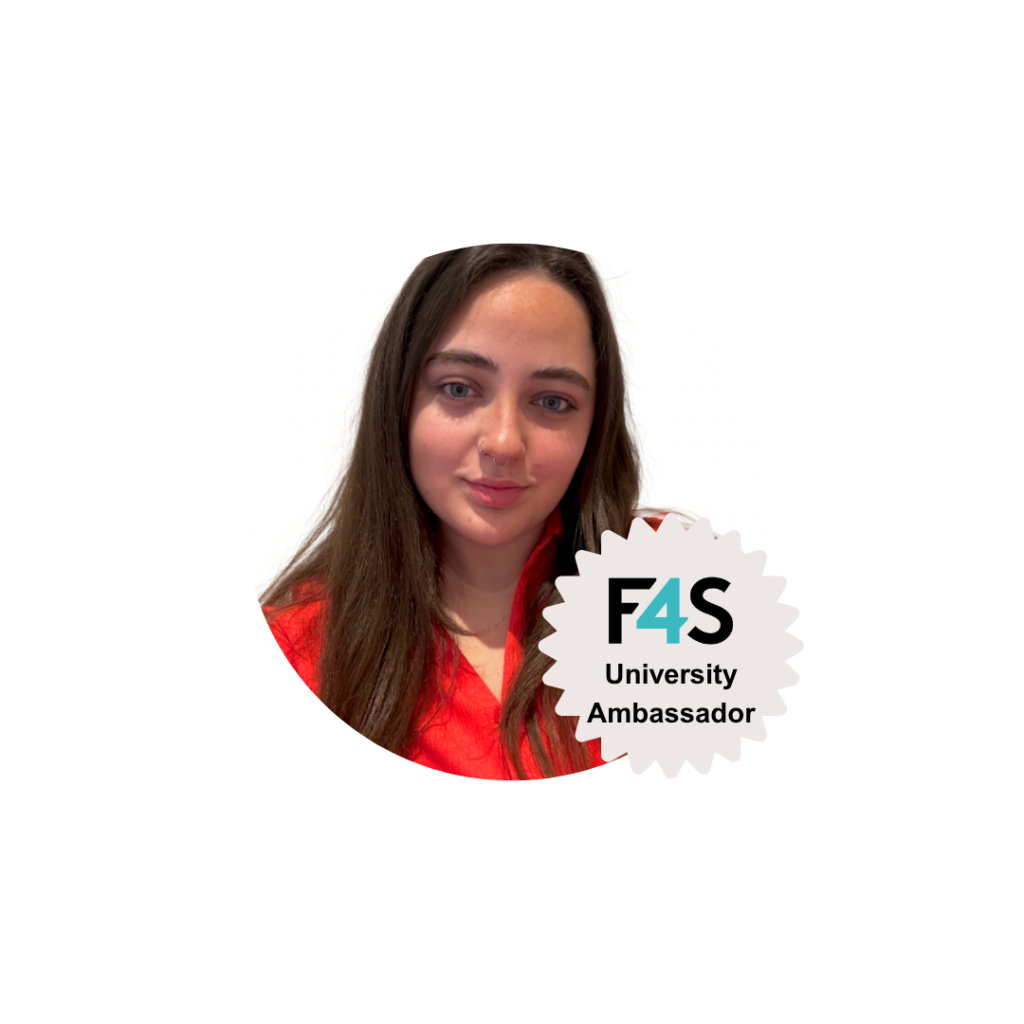
Recently, two of our University Ambassadors were invited to speak to students at Callerton Academy in Newcastle. Erin Wood started volunteering with F4S last year and is passionate about sharing her love of mathematics with the younger generation. She has spoken at our virtual assemblies and hosted her own 1:1 career acceleration sessions with schools.
Her journey hasn’t been without its challenges, and she understands how helpful it would have been to have had someone to turn to for career advice when she was younger. That’s why she is driven to share her experience and support students looking to follow in the same footsteps! 🌟
We asked her a few questions about his experience with F4S and talking to the students at Callerton Academy in Newcastle. Here’s what she said…
Q: What was the event you participated in, and what was your role as a university ambassador?
“I participated in a career acceleration session with Year 10 students, where I gave a 20-minute talk about my journey into medicine. As a university ambassador, my role was to provide real insight into university life and show that the path to a career isn’t always straightforward.”
Q: What surprised you most about the experience?
“What surprised me most was how engaged the students were. They listened attentively and asked thoughtful, well-formulated questions, which made the experience even more rewarding.”
Q: Do you feel like you gained confidence participating in this in-person event?
“Yes, undoubtedly. My entire experience with F4S has significantly boosted my confidence. It has helped me become more comfortable with public speaking and gave me the opportunity to grow and expand my communication skills.”
Q: Can you share a memorable moment or interaction from the day?
“A memorable moment was when a student told me she wanted to pursue medicine but felt held back by her exam progress. I shared my own similar struggles, and I could see that it reassured her to know that someone who had “made it” had also felt like she does now, which was meaningful.”
Q: What would you say to a fellow student who’s thinking of becoming a university ambassador?
“To any student thinking about becoming a university ambassador, I’d say just do it. It’s an incredibly rewarding way to give back and make a real difference to someone else’s journey.”
A huge thank you to Erin for taking the time to give insights and encourage the younger generation! 🙂
You can find full replays from Erin’s virtual assemblies on the resource centre here.
If you want to invite Erin to speak at a virtual assembly, you can find her profile on the platform.
We are so excited to see future talks from Erin 🥳
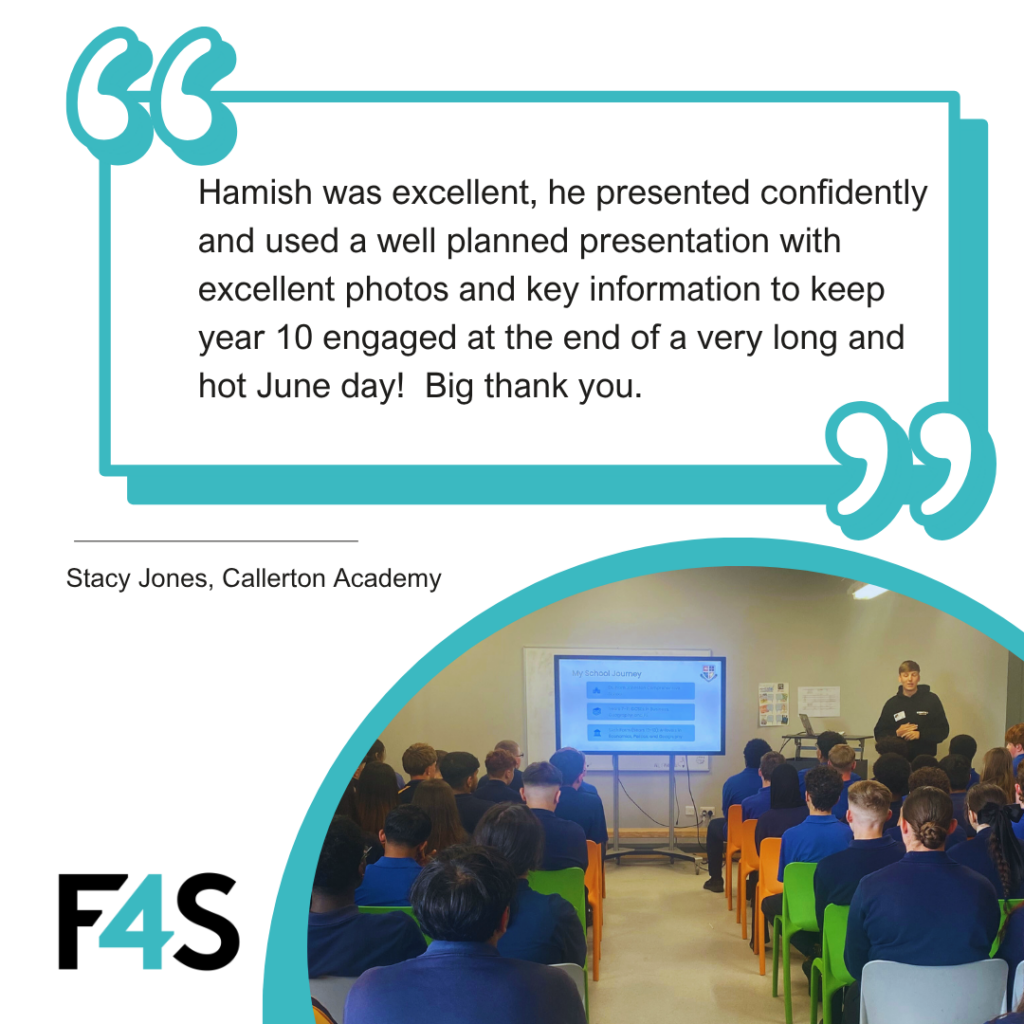
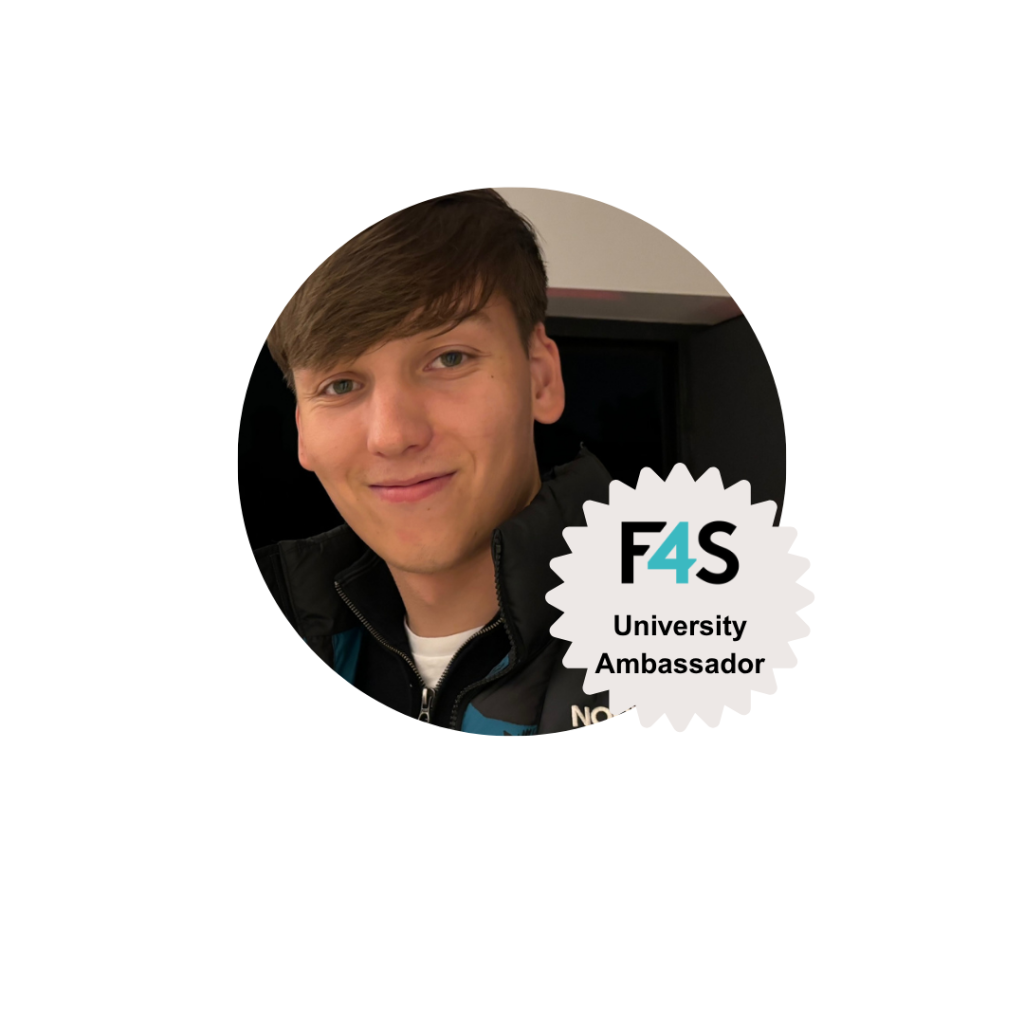
Recently, two of our University Ambassadors were invited to speak to students at Callerton Academy in Newcastle. Hamish Barrie started volunteering with F4S last year and has been a wonderful addition to our community, speaking at several virtual assemblies and leading 1:1 career acceleration sessions with schools in the UK.
Hamish is currently an undergraduate in Accounting and Finance at Newcastle University. When he was in the process of applying to university, he felt it was very daunting, but a little bit of guidance from students undertaking an undergraduate degree was massively helpful. That’s why he decided to be a University Ambassador! 🌟
We asked him a few questions about his experience with F4S and talking to the students at Callerton Academy in Newcastle. Here’s what he said…
Q: What was the event you participated in, and what was your role as a university ambassador?
“Callerton Academy in-person Assembly, presenting my university and educational pathway. My role as a university ambassador was to provide insight and reliability for the students in their educational careers. Stacy mentioned that these were the first university students they had seen, which gave them much more insight into what the next few years may look like.”
Q: What surprised you most about the experience?
“How insightful and knowledgeable the students were about what career paths they wanted to pursue. The engagement the students gave was brilliant, answering questions and coming up with thoughts and ideas on specific topics such as potential career paths and ways to achieve goals and aspirations.”
Q: Do you feel like you gained confidence participating in this in-person event?
“Lots of confidence in public speaking and presentation skills, which will be very useful in my career and last year of university.”
Q: Can you share a memorable moment or interaction from the day?
“The most memorable moment/interaction was being able to ask questions and listen to answers from the students. The vast array of answers and aspirations was very interesting, and it was brilliant to hear from a range of students what their goals are for the next few years post-GCSE study.”
Q: What would you say to a fellow student who’s thinking of becoming a university ambassador?
“Fantastic opportunity to be able to give insight and knowledge to younger students. I wish I had an insight into what university was like when I was younger. Being able to give back and provide this to students not only benefits you, in terms of CV/Career Skills, but also massively helps the students in their understanding of university and higher education.”
A huge thank you to Hamish for taking the time to give insights and encourage the younger generation! 🙂
You can find full replays from Hamish’s virtual assemblies on the resource centre here.
If you want to invite Hamish to speak at a virtual assembly, you can find his profile on the platform.
We are so excited to see future talks from Hamish 🥳
Every month, we choose one of our incredible volunteers to highlight to show their impact in our community. We look at the platform scores and feedback from schools to pick our Volunteer of the Month, which allows our volunteers to learn more about each other. This month, we’re celebrating Liyana, one of our wonderful volunteers who has contributed to the F4S community.
Liyana is the Group Communications Manager at Brambles, implementing communication initiatives and contributing to programs that actively engage internal audiences on a global scale.
Beyond her professional achievements, Liyana serves on the Future Leaders Shadow Board of Women in Banking & Finance UK (WIBF), where she shapes strategies to foster inclusivity in the financial services sector.
We received some wonderful feedback from a school in our community about Liyana:
“Liyana was an excellent mentor. She attended in person and carefully planned a session which helped our young girls feel inspired, motivated to find internships/work experience, and learn that STEM careers involve careers which interlink with communication, HR, and marketing, to name a few. She was friendly and presented very well…”
Do you want to book Liyana for a session with your school? Reach out to her here.
Thank you for volunteering with us, Liyana! We look forward to seeing the wonderful work you do at F4S. 🙂
At F4S, we know that preparing young people for the future means connecting classroom learning with the fast-evolving world of work. That’s why we’re excited to unveil this year’s F4S National Careers Programme themes—a powerful monthly series designed to ignite curiosity, showcase real-world innovation, and spotlight careers in future-focused sectors.
Developed in collaboration with educators, industry leaders, and academic calendars, each monthly theme aligns with key awareness dates and national priorities. From AI and sustainability to creative industries and defence technology, we’re helping students across the UK explore meaningful career paths with the support of role models and innovative scale-ups leading change.
Here’s what’s coming up this year:
September – Defence Technology
The UK’s defence sector is a global leader, with the government committed to increasing defence spending to 2.5% of GDP, recognising the critical role defence and national security play in both protecting the nation and driving economic growth. Supporting around 434,000 jobs—equivalent to 1 in every 60 UK jobs—the sector offers well-paid, high-impact careers across engineering, technology, intelligence, and logistics. For students, learning about defence tech provides valuable insight into real-world issues like cybersecurity, global conflict, and technological sovereignty, while also showcasing how the sector drives innovation in AI, robotics, materials science, and quantum computing.
With major industry events such as London Defence Week and the Defence and Security Equipment International (DSEI) exhibition taking place in September 2025, it’s the ideal time to spotlight this fast-growing industry. Through real-world examples and inspiring encounters with professionals, students can connect classroom learning with cutting-edge developments and see the exciting and meaningful career opportunities available in defence technology.
October – Aerospace & Engineering
The aerospace and engineering sector is a vital driver of innovation, sustainability, and national security in the UK and beyond—contributing over £30 billion to the UK economy and supporting hundreds of thousands of highly skilled jobs. From designing aircraft and spacecraft to developing cutting-edge technologies that power everything from clean energy systems to robotics, this industry shapes how we move, live, and explore. With World Space Week taking place from 6–12 October, it’s the perfect time to spotlight the role of aerospace and engineering in advancing science and tackling global challenges. Rapid developments in space exploration, green engineering, and artificial intelligence make this a future-facing field with exciting career prospects.
Through real-world examples and inspiring encounters with professionals, students can see how engineers and aerospace experts turn bold ideas into reality—building the future and equipping themselves with problem-solving, creativity, and resilience along the way.
November – Cybersecurity
Cybersecurity is a critical pillar of the UK economy, now valued at over £10 billion and growing rapidly as digital threats become more complex and widespread. With businesses, governments, and individuals increasingly reliant on digital systems, the demand for skilled cybersecurity professionals has surged—offering high-paying, future-proof careers that are essential to our digital infrastructure. The sector plays a vital role in protecting sensitive data, financial systems, and national security, making it a crucial area for students to understand.
December – Manufacturing
Manufacturing is a vital part of the UK economy, creating high-value jobs with above-average wages and spreading opportunity across the country. It underpins many key service sectors, drives innovation, and plays a crucial role in building economic resilience. As the UK works toward a net-zero future, manufacturing will be central to delivering clean energy solutions and advancing sustainable technologies. With estimated annual investment needs of £50–60 billion through the late 2020s and 2030s, the sector is poised for major growth and transformation.
We’re spotlighting Manufacturing Month in December to align with National Manufacturing Day and to highlight the industry’s progress and potential. By connecting students with role models working across diverse manufacturing roles, we aim to bring the sector to life, show its real-world impact, and inspire the next generation to see themselves in high-skilled, future-focused industrial careers.
January – Creative Industries
The creative industries are a powerhouse of innovation and cultural influence—contributing over £115.9 billion annually to the UK economy and employing more than 2.3 million people across fields like design, media, fashion, film, music, advertising, and the arts. Growing at more than twice the rate of the wider economy, this dynamic sector offers students exciting career opportunities that blend creativity with digital innovation, sustainability, and entrepreneurship. The theme will help students see how their talents in storytelling, design, performance, and problem-solving can lead to real-world success. By highlighting the sector’s impact on both the economy and our daily lives, students will gain insight into diverse, future-ready pathways that connect passion with purpose—empowering them to thrive in one of the UK’s most vibrant and fast-growing sectors.
February – AI, Machine Learning & Robotics
Artificial Intelligence (AI) is transforming the way we live, work, and solve complex problems—making it one of the most exciting and impactful sectors of the modern economy. From healthcare and transport to finance and entertainment, AI, machine learning, and robotics are driving innovation across industries. With over 75% of companies planning to adopt these technologies within the next five years, the demand for digitally skilled professionals is rapidly rising. Careers in AI offer students the chance to shape the future, tackle global challenges, and work on technologies that improve lives. This is an ideal time to explore this theme, with AI featured prominently in global conversations about ethics, automation, and the future of work. By showcasing real-world applications and connecting with inspiring role models, students can see how AI skills—like coding, data analysis, and problem-solving—open doors to cutting-edge, future-proof careers.
March – Sustainability
Sustainability is at the heart of building a better future—and with growing demand for green skills across every industry, it offers some of the most meaningful and impactful career opportunities today. Sponsored by Hitachi Energy, our March theme coincide with British Science Week and will spotlight inspiring employees working to power a more sustainable world.
As environmental responsibility becomes increasingly urgent, students will explore careers in carbon reduction, sustainable engineering, green technologies, and climate consulting. This theme also celebrates the contributions of women in sustainability in aid of International Women’s Day, highlighting diverse role models who are driving change across science, technology, and business. Through real-world insights and personal stories, students will see how their career choices can help protect the planet and shape a fairer, greener economy. It’s a unique chance to ignite ambition and equip young people with the knowledge and motivation to become the next generation of sustainability leaders.
April – Fintech
FinTech—where finance meets technology—is one of the fastest-growing and most transformative sectors in the UK, revolutionising how we bank, invest, make payments, and manage money. Valued at over £11 billion and continuing to expand, the UK’s FinTech industry is a global leader, driving innovation in digital banking, blockchain, AI, open finance, and sustainable financial solutions. With increasing demand for secure, efficient, and tech-enabled financial services, FinTech offers diverse, high-growth career paths that combine skills in technology, data, problem-solving, and entrepreneurship.
As we celebrate FinTech Week in April, it’s the perfect time to spotlight this exciting sector. Through real-world case studies and role model encounters, students can explore how FinTech is shaping the future of money, understand its impact on everyday life, and gain inspiration to develop the digital and analytical skills needed for success in this dynamic industry.
May – Life Sciences
The life sciences sector holds immense potential to transform the future—driving economic growth, boosting productivity, and significantly improving health outcomes for people across the UK. From developing cutting-edge medicines and vaccines to advancing diagnostics and biotechnology, life sciences deliver innovations that are essential to the wellbeing of society and the resilience of our economy. This was especially clear during the pandemic, where rapid scientific breakthroughs played a key role in global recovery.
The UK’s life sciences sector is already world-leading, with over 6,800 businesses generating more than £100 billion in turnover (2021–2022). It’s supported by a strong ecosystem that includes four of the world’s top ten universities for life sciences and medicine, a thriving research community, and the unparalleled expertise of the NHS. By spotlighting life sciences in our careers programme, we can help students understand how science is applied to solve real-world challenges, inspire them with role models working at the forefront of innovation, and open doors to exciting, high-impact careers in health, biotech, pharmaceuticals, and beyond.
Through virtual assemblies, mentoring, and access to inspiring role models, the F4S National Careers Programme helps students see how their skills and interests align with the real world. We're proud to support educators and employers in bridging the gap between education and the industries shaping our future.
Stay tuned each month as we spotlight a new theme—and inspire the next generation of innovators, creators, and changemakers.
At F4S, we marked National Numeracy Day in style—with a celebration of how mathematics empowers discovery, creativity, and real-world impact.
This special day was the perfect opportunity to help students see that maths is more than numbers—it’s a language that shapes the world around us. To bring this message to life, we spotlighted the stories of remarkable women whose mathematical brilliance changed history.
What We Did
This year, we focused on inspiring students through the stories of women in mathematics—figures who have used their mathematical brilliance to make history, challenge stereotypes, and shape the future.
By sharing these stories, we aimed to help students see that maths is not just about equations—it’s about exploration, impact, and identity.
Meet the Trailblazers:
🌟 Katherine Johnson A pioneering African-American mathematician, Katherine Johnson played a crucial role in NASA’s early space missions—calculating the flight paths for both the first American in space and the Apollo 11 moon landing. Her precision and perseverance changed the course of science and history. 📣 “Girls are capable of doing everything men are capable of doing.”
🌟 Maryam Mirzakhani Maryam Mirzakhani was the first woman to win the prestigious Fields Medal 🏅, often called the “Nobel Prize of Mathematics.” Her groundbreaking research on geometry and surfaces continues to influence the field today. Her journey encourages students to approach problems with patience and passion. 📣 “The beauty of mathematics only shows itself to more patient followers.” 🧠✨
🌟 Sophie Germain A self-taught mathematician, Sophie Germain defied the norms of her time by studying under a male pseudonym. Her contributions to number theory and elasticity continue to inspire. Her story is a testament to resilience and the power of self-belief. 📣 “Algebra is nothing more than geometry, in words; geometry is nothing more than algebra, in pictures.” 🎨➗
🌟 Hypatia of Alexandria Living over 1,600 years ago in ancient Egypt, Hypatia was a philosopher and mathematician who taught geometry, algebra, and astronomy. At a time when women were rarely seen in such roles, her pursuit of knowledge and teaching preserved key Greek mathematical ideas. 📣 Hypatia’s life shows us the enduring power of curiosity, courage, and education.
By sharing these stories, we aimed to help students see that maths is not just about equations—it’s about exploration, impact, and identity.
Set a Student Challenge
To build on this inspiration, we set students a challenge:
Plan a weekend inspired by one of these pioneering women—and put their numeracy skills to the test!
From travel costs and entry fees to food and fun, this activity helps students practice budgeting, savings, and decision-making in a creative, real-world context.
Looking ahead, there are plenty of ways for teachers to bring the spirit of National Numeracy Day into the classroom year-round:
Incorporate real-world maths stories into lessons—link topics like algebra, geometry, or data with the people and problems that make them matter.
Introduce students to diverse role models in STEM—use our resources to showcase mathematicians from different backgrounds, cultures, and industries.
Encourage reflective conversations—ask students how they see maths in their own lives, their communities, or the careers they aspire to.
Use our Career Acceleration Sessions to help students connect numeracy skills with future pathways—from tech and engineering to entrepreneurship and creative industries.
On Tuesday 20th May 2025, Maths4Girls and Macquarie Group hosted an inspiring Virtual Assembly aimed at encouraging more girls to explore the power and potential of studying maths beyond GCSE. The event welcomed students aged 11–14 from across the UK and gave them the opportunity to hear directly from three trailblazing women at Macquarie who use maths daily in diverse, high-impact roles.
Why Maths4Girls Matters
Maths4Girls connects students with relatable, real-world role models who show how mathematical skills can lead to exciting, meaningful careers. In a world where the gender gap in STEM persists, initiatives like this are essential. Maths4Girls doesn’t just break down stereotypes—it empowers girls to imagine themselves in industries where women are still underrepresented.
Real Stories, Real Impact
Bex Kimberley
Varsha Balraj
Kimberley McDonald
The Virtual Assembly featured three brilliant women, each offering unique insight into how maths drives their careers and shapes the industries they work in:
Kimberley McDonald – Associate Director
Kimberley spoke about leading global financial projects and how AI is transforming the way they work. She encouraged students to stay confident, curious, and to embrace diverse interests—like drama and maths—as part of creating a unique career path.
Bex shared her journey from aspiring pop star to a leader in financial crime risk projects, where she protects systems across the world. She highlighted how mathematical reasoning underpins her work and enables her to respond to fast-evolving threats.
Varsha Balraj – Data Analyst
Varsha described her transition from studying engineering and biology to working in tech. From cancer research to financial data, she applies her analytical mindset to uncover trends and deliver insights that drive decision-making across global markets.
Together, these women showcased the breadth of careers that use maths every day—from safeguarding systems to analysing markets and driving innovation.
What Students Learned
The session gave students insight into how maths is applied in a wide range of careers—from financial crime risk and artificial intelligence to global data analysis. Each speaker shared how mathematical thinking plays a central role in their day-to-day work.
Bex Kimberley explained how her perspective on maths changed when she started using it in practical settings:
“As soon as I started applying it to a real-world scenario, I found it really interesting—and I was much better at it than I ever was in a school setting.”
Kimberley McDonald encouraged students to see maths not just as an academic subject, but as a long-term advantage.
“Keep pursuing it to the highest level of you can - because it truly is a superpower on your CV and opens a lot of doors.”
https://youtu.be/-M91wMtvjek?si=fTQ9gdlbLOPakQd1
Varsha Balraj spoke about how Maths has empowered her:
https://youtu.be/UfP70kNBH44?si=1zQVGqNCVhjlA7FL
By hearing directly from professionals working across tech, finance, and data, students were shown the relevance of maths beyond the classroom and introduced to examples of women succeeding in fields where female representation is still growing.
Join the Movement
This event highlighted the power of representation, relevance, and real-world connection. Maths4Girls continues to offer free sessions that connect young people with role models across finance, tech, healthcare, engineering, and more.
👉 Educators and industry professionals: Help us inspire the next generation—sign up here.
At F4S, we know that representation matters—especially when students are exploring their place in the world of work. That’s why we’ve launched new accessibility settings: a new way for users to self-identify with a disability, neurodivergent condition, or long-term health condition so they can be more meaningfully matched with individuals who value lived experience.
What Are The New Accessibility Settings? 💻
These settings are now available in your F4S profile, allowing you to indicate whether you live with a disability or condition, including mental health, chronic illness, neurodivergence, and more. These settings are entirely optional, private by default, and can be updated at any time.
The purpose? To help educators connect with volunteers whose backgrounds reflect their students’ experiences. If a teacher is working with a student who is visually impaired, neurodivergent, or living with a chronic illness, for example, they can now request to hear from someone who truly understands that journey. This can make for a richer, more empowering session—one where students not only learn about careers, but also feel seen.
When setting up or editing your profile, you can now choose from a range of accessibility preferences based on needs related to:
Chronic Illness
Physical Disability/ Mobility Issues
Neurodivergent
Visual Impairment
Deaf/Profoundly Deaf
Hearing Loss
Learning Difficulties
Mental Health
Other
https://youtu.be/Kq8sbblA1Gg?si=nTSreqavTOIMlApj
Adjusting the accessibility settings is:
1️⃣ Voluntary 2️⃣ Customisable at any time 3️⃣ Private by default
And don’t worry—this information stays private by default. You control who sees it. You can update accordingly when it suits you.
Here’s how you can adjust your profile:
Log in to your volunteer account.
Navigate to the profile settings section.
Update the “Profile Settings” by ticking Yes or No in the relevant box.
This new disability feature is entirely optional, but it enables teachers who have students with disabilities in their classrooms to invite role models with similar hidden disabilities to speak to their students so they can appreciate the potential roles they might hold in the future.
Why It Matters 🤔
Too often, students with disabilities or additional needs don’t see themselves represented in career talks or role models. But we know from experience that hearing from someone who’s “been there” can be transformational.
These accessibility settings help bridge that gap, making it easier for schools to find speakers whose lived experiences can resonate deeply. These aren’t just career talks—they’re moments that can reshape ambition, spark confidence, and break down barriers. 🚀
Let's Build a Platform Where Everyone Belongs 🏡
At F4S, our volunteer community is full of diverse and inspiring people who have a unique perspective on the working world and finding your place as someone with a disability. We want to give you the opportunity to share this with the next generation and break down stereotypes.
Got feedback? Want to help us improve? Email us at contact@founders4schools.org.uk- we’d love to hear from you! 😊
We’re so excited you’ve booked a Career Acceleration Session with F4S!
Together, we’re working to inspire young people everywhere and show them the full range of career possibilities available to them. We can’t wait for your students to meet our incredible volunteers and be inspired by their stories.
Before your session, we’ve put together a quick briefing to help you feel confident and prepared. It includes everything you need to know to make the most of your session.
Once a volunteer has accepted your request for a session!
On your Dashboard, you’ll now see your session under ‘Mentoring’. It will show you the date, time, and volunteer for your session as well as the all-important ‘join session button’ - but you won’t need to use that until the day!
How to best prepare your students for a Career Acceleration Session?
At F4S, we’re committed to helping you deliver high-quality, impactful employer encounters that truly benefit your students.
With the upcoming changes to the Gatsby Benchmarks taking effect from September 2025, there will be a renewed focus on the quality of these experiences. In line with Benchmark 5: Encounters with Employers and Employees, educators will need to place greater emphasis on what makes an encounter meaningful—including the importance of variety, student preparation, and fostering a real understanding of the world of work.
We’re here to support you every step of the way to ensure your employer encounters are not only compliant, but truly transformative for your students.
Before the session, there are a few simple but important steps you can take to help your students get the most out of the experience:
Set the context and purpose Explain why you’ve organised the Career Acceleration Session. This could be in response to specific questions your students have asked about career pathways, a way to connect curriculum learning to real-world applications, or to show how your subject links to a wide range of future careers.
Introduce the volunteer Give students a brief overview of who they’ll be meeting. Share a little about the volunteer’s background, their career journey, and what they’ll be discussing. This helps students feel more prepared and engaged.
Encourage questions Ask students to think in advance about what they might want to ask. Prompt them to consider what they’re curious about—whether it’s the speaker’s role, career path, industry, or skills required.
By taking a few minutes to prepare students beforehand, you’ll help ensure the session is meaningful, engaging, and impactful.
What Will Volunteers Cover in a Career Acceleration Session?
Each Career Acceleration Session is unique—our volunteers will tailor their talk based on the information you provided when booking, as well as the interests and questions of your students. However, there are a few key areas we encourage all volunteers to cover to ensure a rich and engaging experience:
Their current role – what it involves and why they chose it
What they enjoy most about their job
Their career journey – how they got to where they are today
Challenges they've faced – and how they’ve overcome them
What they thought they’d be doing when they were 12
How a particular school subject has helped them succeed in their career
Volunteers will also make sure to respond to any student questions submitted in advance, and every session ends with a live Q&A to give students the chance to ask anything else they’re curious about.
These sessions are designed to inspire, inform, and help students see the real-world possibilities ahead of them.
How to Make the Most of Your Career Acceleration Session
To ensure your session runs smoothly and has the biggest impact, here are a few quick tips to help you prepare:
Add the session to your calendar Click the calendar icon when you receive your session confirmation and select your preferred online calendar to add it automatically.
Reach out to your volunteer in advance We recommend sending a quick message to introduce yourself before the session. This is a great opportunity to:
Share any specific topics you’d like them to cover
Let them know about any additional needs or context about your students
Ask any questions you or your students might already have
Get your tech ready If your session is virtual, make sure your setup allows the volunteer to be seen and heard by all students. Test your equipment and connection in advance so everything runs smoothly on the day.
Prepare for in-person visits If your session is happening in-person, be sure to provide the volunteer with:
Clear instructions on where to go when they arrive
Details of what they may need to bring
Contact information in case they need help finding the location
Encourage questions! These sessions are a fantastic opportunity for students to hear directly from someone in the world of work. Encourage them to ask questions—they’ll get more from the session, and it helps make the experience more interactive and meaningful.
By taking a few simple steps in advance, you’ll help create a memorable and inspiring session for your students.
After Your Session…
Take time to reflect with your students Once your session with the volunteer has finished, it's important to give students the chance to reflect on what they’ve learned. We recommend setting aside 15–20 minutes during your next lesson or tutorial for this. You can guide the reflection using some of the following questions:
What’s one thing you learned today that surprised you?
What did you find most interesting about the volunteer’s career or journey?
What skills or qualities did the speaker have that seemed important in their role?
What could you start doing now to explore a career like the one discussed?
What transferable skills (e.g. communication, problem-solving, teamwork) did the speaker use?
Has this session changed your thinking about your future? If so, how?
What would you like to learn more about after this session?
Leave feedback for your volunteer Feedback helps our volunteers continue to improve and ensures future sessions are even more impactful. Don’t forget to take a few minutes to share your thoughts after the session.
Want to connect again? If your students found the session particularly inspiring, feel free to message the volunteer to request a follow-up session.
Book another session! There’s no limit to the number of volunteers you can connect with. Explore our platform and book another session to keep the inspiration going.
Each month, we showcase outstanding volunteers who are making an impact on the futures of students. This month, meet Alex Williams, who is doing his PhD in AI and Music at Queen Mary University of London. We selected Alex as he has received wonderful feedback from our schools and has scored high on our rating system. His dedication to helping the younger generation through his involvement in speaking at recent virtual assemblies and volunteering his time is the reason we wanted to highlight his work with F4S! 🙂
Alex's current position is as an academic researcher with multi-disciplinary experience in areas of computer science, engineering, and music technology. His research focuses on artificial intelligence, computational creativity, and music information retrieval.
In April, Alex spoke at one of our virtual assemblies about his career and how he developed an interest in Artificial Intelligence.
You can find the full replay on your dashboard in the resource centre! 💻
Our London Regional Coordinator, Adriana Ennab, said:
"Alex Williams was a standout speaker who brought warmth, insight, and authenticity to the session. He challenged the idea that STEM and creativity are separate, showing how following your passions can lead to unexpected and fulfilling career paths. What made Alex especially memorable was his ability to connect with students and speak honestly about his journey. As he put it: “There isn't that much of a separation between the creative industry and STEM… Don’t give up on your passions—I wouldn't be where I am if I had neglected my interests.”
Having Alex as part of the session made it feel not only inspiring but deeply relevant to how young people think about their future. He’s a brilliant example of what it looks like to bring your full self to your work.
We were thrilled to have him join us. "
During his conversation with F4S, he shared insights on the importance of finding a career that blends your personal passion with technical skills. He encouraged students to be ambitious and that they don't need formal music training to explore music technology. The field of AI music is growing, and there are lots of exciting opportunities in the field.
The overall message from Alex to students is to explore interdisciplinary paths that combine creativity and innovation. 🚀
Thank you for taking the time to speak at our virtual assembly, Alex! We look forward to seeing the wonderful work you do at F4S. 🙂
A key takeaway from recent events and industry discussions is the vital role of inclusion in preparing the next generation of talent. As part of its ongoing commitment to inclusive education, F4S has introduced a new disability-inclusive feature designed to better connect educators and students with mentors who have lived experience with disability.
By highlighting role models from diverse backgrounds, F4S is helping shift inclusion from a “nice to have” to a “must have” for schools striving to meet today’s diversity and accessibility standards.
What’s new?
Educators can now update their matching preferences—for themselves or their students—to prioritise connections with volunteers who have disclosed specific conditions. This helps ensure that career conversations are not only more relatable but also empowering.
Representation Matters
Students often need to see people who share their experiences to truly believe they can succeed in STEM or other career fields. By proactively matching disabled volunteers with educators, F4S ensures that young people can envision themselves thriving in roles and industries where they may not have otherwise felt welcome.While many school programs emphasise careers education, few systematically highlight opportunities for students with disabilities. F4S fills this gap by integrating a range of volunteer professionals with disabilities, thereby normalising disability in the workplace and demonstrating that it’s not a barrier to success.
Enhancing Educator and Parent Buy-In
When schools adopt the F4S platform, they aren’t just broadening career exposure for students; they’re also championing inclusivity. This alignment with legal mandates (such as the Equality Act), social expectations, and the wider push for equity in education positions F4S as a practical partner for modern schools.By tracking the engagement of volunteers with disabilities, F4S can quantify its impact. This data allows schools to show measurable improvements in students’ aspiration levels, self-confidence, and career clarity, particularly among those who identify as disabled or have special educational needs.
Elevating Mentorship to a Core Requirement
In today’s world, awareness of equitable access is no longer optional. Through its disability-inclusive matching, F4S demonstrates that mentorship programs aren’t just add-ons; they’re essential pillars of 21st-century careers education. By building programs around real-world representation, F4S helps shift mentorship from a “nice to do” extracurricular to a vital part of preparing all students for the future workforce.
Below are the core components that make F4S a standout partner for schools.
Feature
Key Point & Description
Disability-Inclusive Matching
Proactive Identification & Pairing: F4S actively matches educators with disabled volunteers, ensuring students see mentors who share their lived experiences.
From ‘Nice to Have’ to ‘Must Have’: As schools work to fulfill inclusion mandates and meet student expectations, F4S’s system helps institutionalise real-world representation in everyday learning.
Seamless Technology & Local Engagement
User-Friendly Platform: Teachers can find and schedule mentors from their immediate community with ease, reducing logistical hurdles and encouraging ongoing, relationship-driven support.
Localised Approach: By focusing on mentors in a school’s surrounding area, F4S not only connects students to career opportunities close to home but also nurtures sustainable, long-term engagement beyond one-off talks.
Broad, Industry-Spanning Expertise
Panoramic View of Careers: While many programs emphasise either STEM or entrepreneurial skills, F4S embraces all industries, exposing students to a wide spectrum of pathways.
Diverse Volunteers: From successful entrepreneurs to corporate leaders, F4S ensures that every student can connect with a mentor who resonates with their individual interests and aspirations.
Real-Time Impact Measurement
Data-Backed Insights: F4S provides schools with feedback loops to track changes in student aspirations, engagement levels, and self-confidence.
Clear ROI: This evidence helps educators, parents, and policymakers see the direct return on mentorship-driven, inclusive initiatives—a powerful tool in decision-making for future programs.
Commitment to Collaboration & Growth
Strategic Partnerships: Collaborations with organisations like Innovate UK place F4S at the forefront of emerging trends, ensuring that its offerings align with both industry needs and government priorities.
Curriculum Integration: By fitting seamlessly within existing career frameworks and academic curricula, F4S moves mentorship from the sidelines to a core educational requirement that schools actively embrace.
Sign up to our newsletter
Join our newsletter community to be the first to hear about our learning programmes, events, and resources to support educators and students! 🚀